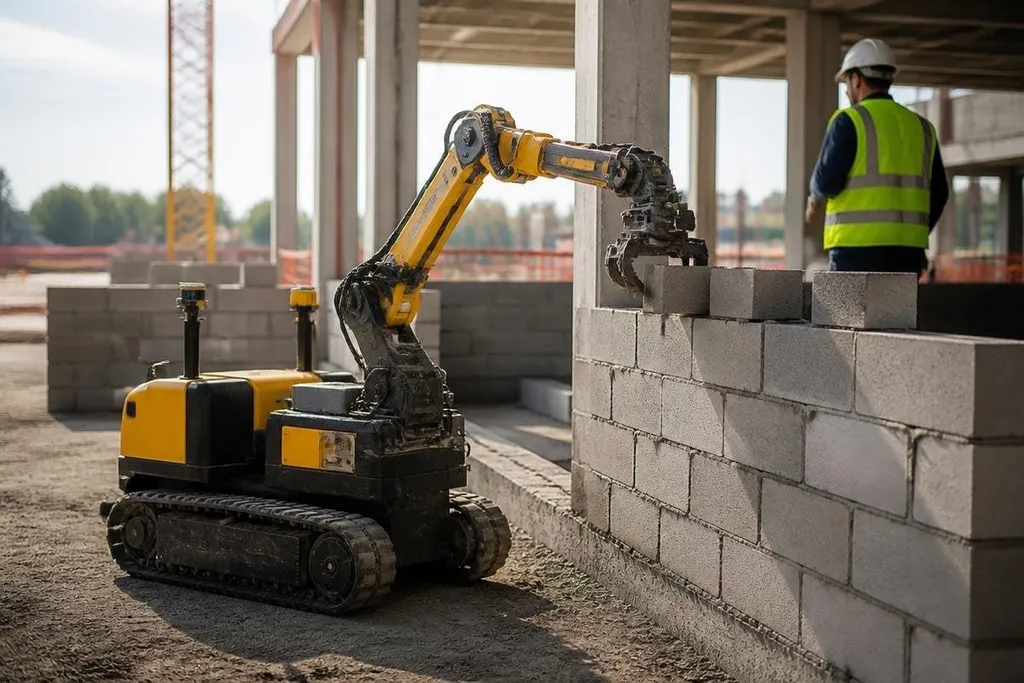
A construction site asks people to repeat hard tasks in changing conditions. Robots are becoming more useful when they can handle one narrow job for hours, such as moving materials, placing bricks, scanning a structure, or printing concrete.
The case for these machines rests on task fit. The machine does not need to replace a whole crew to help; it needs to take on work that is slow, risky, or hard to staff.
Quick read
- Robots work best on repeatable site tasks with a clear start and finish.
- Autonomous systems can keep moving materials or scanning areas while workers handle decisions.
- Weather, rough ground, changing plans, and setup time still limit where robots make sense.
Construction work has a repeat problem
Each project changes, yet parts of the work repeat for hours. A machine that moves blocks, drills holes, scans a floor, or carries loads can follow the same basic cycle without asking a worker to repeat it by hand.
That matters when a crew is small or a task keeps people near falling objects, moving equipment, dust, or height. Remote control can put distance between the worker and the hazard. Autonomy can let the system repeat a defined route after a person checks the work area and sets the limits.
The useful question is not whether a robot looks like a worker. Ask which task consumes time and attention, then check if its setting stays stable enough for a machine to handle.
What the machines can do
Construction robots now fit several clear job types. Robotic arms can place bricks or spray material along a planned path. Mobile robots can carry tools and supplies across a site. Scanning systems can build a 3D map that shows where installed work differs from the plan.
Concrete printing uses a related idea. A nozzle places wet concrete in set layers, so the software controls the path and the speed. The method still depends on material flow, weather, curing, and a surface that can support the printer.
Earthmoving machines take a different route. Sensors can help an excavator or dozer keep to a planned grade, which is the target height and slope of the ground. A person still needs to check the soil, nearby equipment, and changes that the plan did not include.
A construction robot’s value depends on the job it finishes, the site conditions, and the help people still give it. Reports that name the machine, test site, date, and task let you check those details through Robot24 before weighing the wider costs. That leads to the next question: what does the machine add beyond fewer hours of manual work?
Why the value reaches beyond labor
These machines can affect a project in four practical ways. They may keep a repeat task running for longer, reduce the number of workers exposed to a hazard, collect site data more often, or make output more consistent.
Those gains only matter if the machine fits the site. A robot that needs a flat floor, a fixed route, and a technician nearby may work inside a new building but struggle on a road project. A bricklaying arm may place blocks quickly, yet still wait for materials, layout checks, and a person to handle corners.
The cost also includes setup. Someone must move the robot, charge it, inspect it, set its work area, and fix errors. If those jobs take longer than the manual task, the robot adds work instead of removing it.
I’d buy construction robots for repeat work before buying them for general site labor.
Limits that still shape the choice
Construction sites change every day. Ground shifts, materials arrive late, people enter work zones, and plans change after the first wall or trench appears. A robot trained for one layout may need a new map, new limits, or a new work path after a small site change.
Safety adds another layer. The machine needs clear stop controls, a defined operating area, and a process for checking people and equipment near its path. A remote operator also needs a reliable connection and a clear view of what the robot is doing.
The open question is economics. A project team needs its own figures for machine rental or purchase, transport, training, supervision, repairs, and lost time during setup. Without those numbers, a robot may look useful on paper and still fail the budget.
A practical site check
Use these questions before choosing a machine:
- Name the task: Can you describe the job as a repeatable cycle with a clear result?
- Check the setting: Will the ground, route, lighting, and work area stay stable long enough?
- Count the people: Who loads material, watches the machine, checks the output, and fixes errors?
- Test the handoff: Where does robot work stop and skilled human work begin?
- Price the full job: Include transport, setup, charging, training, service, and downtime.
A good first project has a narrow task, a measured result, and a way to stop the machine safely. That gives the crew a fair test without asking one robot to solve the whole site.
Construction robots will matter more as builders match machines to repeat work instead of broad promises. The next useful proof is a project record showing task time, setup time, human supervision, repairs, and total cost on one real site.